
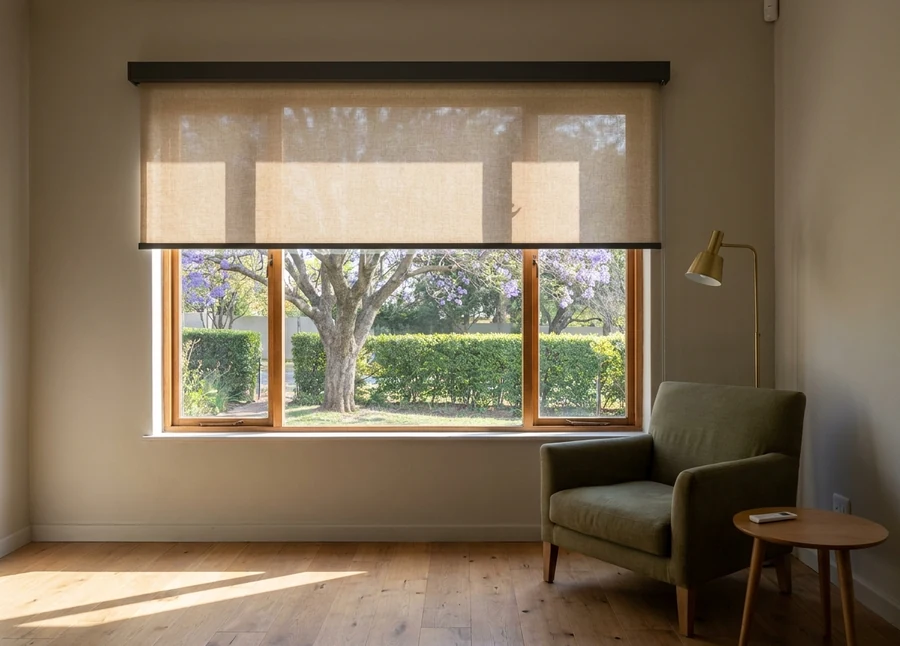
Why a reno is exactly where motorisation earns its keep
An open-plan extension usually means wider spans, taller glass and a wall of blinds instead of one or two. Chains on six linked blinds across a stacking door is a lot of walking back and forth; one button — or one scheduled sunrise — is the point of automating it.
Power options
Rechargeable battery motors need no wiring and suit a retrofit onto an existing opening — charge every few months via a USB-style charger. Wired 220V motors are the better call for a new build or a full renovation where the electrician is already on site: permanent power, no charging, and the standard for big or heavy systems and exterior products.
Control layers
A handset remote can run a single blind or every blind in the house from one multi-channel unit. App control puts the blinds in your pocket — useful for the "did I leave the west blinds up" question after you've left for work. Schedules can open bedroom blinds at sunrise and drop west-facing ones automatically in summer afternoons. Sun sensors do the same job without a schedule, and wind sensors are the safety-critical layer on exterior products — retracting awnings and screens ahead of a highveld storm before it does the damage. Voice and smart-home integration round it out for anyone already down that road.
When it's essentially required
Spans too wide or heavy for a chain, blinds over a stair void or double-volume space, concealed ceiling-recess systems, and every exterior product — venetians, awnings, zip screens — all sit in this category. A wall of glass with six separate blinds is the clearest case: one button beats six chains.
What automation adds to the quote
Motorisation cannot be priced on its own, since a motor only ever goes into a product. Everything we motorise falls somewhere in a R2,500 to R7,500 per square metre range, installed. The cheap end is a motorised roller on a normal indoor window. The dear end is anything motorised that has to survive outside, an awning included.
Sensors, keypads and hubs are quoted as their own lines separately rather than swallowed by the square-metre rate, so each window can be judged what deserves a motor. Small openings carry a minimum charge. Every figure here is orientation only — the number that binds comes after the measure, when the motor count, the products they sit in and the power supply for each are all settled.
Motorising homes across the Parks belt
Motorised systems go into open-plan renovations right across the belt — the wide glass runs of Craighall Park and Parktown North, and the linked-blind walls that come with a Parkview or Parkhurst extension.